Types of Braces
Several types of braces can be used to reposition teeth.
Patients can choose from ceramic brackets, stainless steel brackets or lingual braces. (fitted on the inside of the upper teeth.)
Stainless Steel Braces
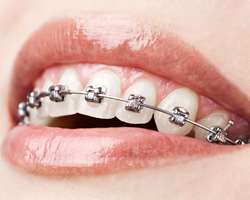 Classic Series
Affordable and popular. The reliable choice for a shiny, classic smile transformation.
Silver braces are the most common braces. They are usually the cheaper option,
and popular with children because they can choose different colours.
In the past, you may have noticed that stainless steel braces were large and quite noticeable, but orthodontics has thankfully come a long way and now you will find that these types of braces are smaller, stronger and less noticeable and still have all the benefits, if not more, than they did before.
Why would someone choose stainless steel braces over other versions available on the market?
Below are just a few reasons why you should consider these a good option for you:
- Stainless steel braces are undoubtedly the most cost-effective option on the market.
- While they might be more visible than other varieties, they are perfect for kids as they can choose from a variety of colours to make use of during their treatment.
- These types of braces are robust and get the job done in the shortest possible space of time.
Take the time to chat to your orthodontist about the options available and take heed of his advice and suggestions.
Ceramic Braces
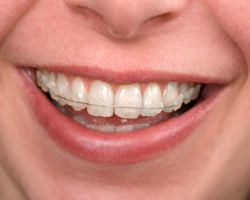 Aesthetic Series
Designed for the cosmetically aware. Clear / tooth coloured, inconspicuous, and are less visible
Many people are worried about the aesthetic appeal of their choice of braces and while often you cannot completely hide the fact that you are undergoing orthodontic treatment, you can lessen the obvious appearance thereof.
Ceramic braces are exactly the same as traditional metal braces in every other way and you can expect for your treatment to last the same amount of time, regardless of which type you choose. Clear braces may however be slightly more expensive with each bracket costing a little more than the metal variety.
Clear Braces function in the same way as silver braces, but cosmetically they are more appealing.
Lingual Braces
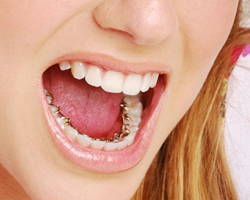 Pro Series
Brackets are placed on the inside of the upper & lower teeth and therefore cannot be seen from the outside.
We don't favour them on the lower teeth as there is too much interference with speech and eating!
During the first few weeks there may be slight irritation of the tongue and the speech may be affected,
but eventually the patient gets used to them.
Not always suitable. Treatment times may be longer and we still may have to finish with outside braces, as not all movements are as effective from behind.
Invisalign Braces
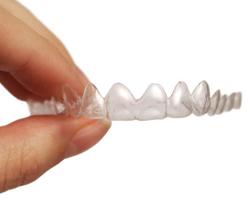 Next-Gen Tech
These braces are known as "aligners" and they consist of clear plastic shells that look like a gum guard.
The teeth are scanned with a 3-D scanner or impressions of the teeth are done and sent to the Laboratory.
A treatment plan is drawn up and the computer makes a number of aligners depending on the complexity of the case. These are worn 22 hours a day for 2 weeks and then replaced with the next set of aligners. They are taken out to eat and brush your teeth.
- The devices can be removed at will, this means that if you have a special event or function, you can remove the braces
- You can brush and floss normally during your treatment
While aigners can be used to treat a variety of orthodontic problems, not all cases are suitable and regular braces may be a better option.
Elastics
You will usually be required to wear elastics during your orthodontic treatment. Elastics help move the teeth and MUST be worn exactly as directed.